
How to Reduce No-Shows at Your Veterinary Practice
The average veterinary practice loses 10-12% of its appointments to no-shows. For a busy clinic, that translates to thousands of pounds in lost revenue each month – slots that could have gone to pets on the waiting list, wasted preparation time, and a schedule that lurches between empty gaps and chaos.
Veterinary no-shows aren't just an accounting problem. They destabilise your day, frustrate your team, and mean some animals don't get seen when they need to be. The good news is that most no-shows aren't malicious – they're the result of forgettable appointments, logistical friction, and poor communication. All of which you can fix.
Why clients don't show up
Before jumping to solutions, it helps to understand what's actually driving non-attendance. The reasons fall into predictable patterns.
Forgetting. The most common cause. A routine vaccine or dental check lacks the urgency of an acute illness. Without an external trigger, the appointment fades from the client's mental to-do list as work, childcare, and daily life take priority.
Perceived low value. Clients unconsciously weigh the effort of getting to the clinic against the benefit. If they view the visit as "just a booster" rather than essential care, it's easily deprioritised when something else comes up.
Cost anxiety. Financial constraints are a silent driver of late cancellations. Clients may book with good intentions, then withdraw as the date approaches due to budget concerns – often too embarrassed to call and cancel, so they simply don't show.
Transport stress. Unique to veterinary medicine: the physical difficulty of getting the patient to the clinic. For cat owners especially, the battle with the carrier can tip the scales toward avoidance. Research suggests 28% of cat owners would visit the vet more often if the experience were less stressful for the animal.
The reminder that actually works
Most practices send reminders. Few send them effectively.
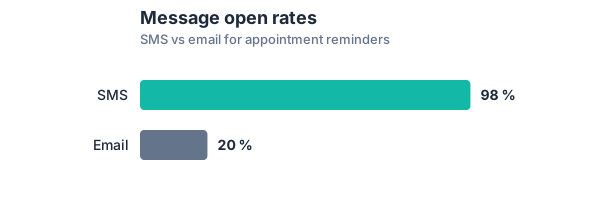
The evidence strongly favours SMS over email or phone calls. Text messages have a 98% open rate compared to roughly 20% for email, and 95% are read within three minutes. More importantly, clients are willing to respond to texts – reply rates are five times higher than email.
But timing matters as much as channel.
The two-step approach:
-
3-4 days before – Send a confirmation request. "Hi [Name], confirming [Pet]'s appointment on [Date] at [Time]. Reply C to confirm or R to reschedule." If they cancel at this point, you have time to fill the slot.
-
24 hours before – Send a reminder. This is the final nudge to trigger memory for tomorrow's logistics. Too late to cancel without consequence, but ensures the appointment is top of mind.
Some practices add a third message 1-2 hours before with practical details: "Please bring a fresh fecal sample" or "Call us from the car park when you arrive." This reduces late arrivals and reinforces that the visit has a specific purpose.
What your reminder actually says
The wording of your message affects whether clients show up. A reminder that says "Appointment: Fluffy, Tuesday 2pm" is better than nothing, but it's purely administrative. It relies entirely on the client's existing motivation.
Compare that to: "Hi Sarah, confirming Fluffy's appointment Tuesday at 2pm. This visit keeps her protection against parvovirus up to date. Reply C to confirm."
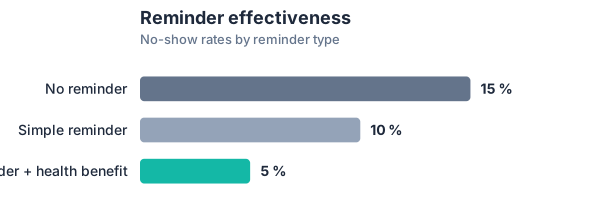
Research on healthcare appointment attendance found that adding health benefit information to reminders nearly doubled re-attendance rates compared to simple appointment notifications. The principle applies directly to veterinary care – connecting the visit to a concrete outcome ("keeps her protected", "catches dental problems early") shifts it from obligation to necessity.
This doesn't require scare tactics. A straightforward statement of why the appointment matters is enough.
Reduce the gap between booking and visit
The longer the gap between booking an appointment and the actual visit, the higher the no-show risk. This is one of the most consistent findings in scheduling research.
An appointment booked three weeks out competes with everything else that happens in those three weeks. The client's circumstances change. The urgency fades. They forget.
Open access scheduling – keeping a portion of your slots available for same-day or next-day booking – addresses this directly. When a client calls because their dog is limping, they're motivated right now. If you offer a slot for this afternoon, they'll show up. If the earliest availability is next Thursday, there's a reasonable chance they won't.
Studies on open access scheduling in outpatient clinics found it reduced no-show rates by 13-30% in most implementations. One family medicine practice saw rates drop from 30% to 17%.
You don't need to convert your entire schedule. The practical approach is to reserve "urgent care blocks" – specific slots each day (perhaps late morning and late afternoon) that aren't available for advance booking. They're released same-day for acute cases or, if unfilled by mid-morning, opened to clients on the waiting list.
When deposits make sense
Financial commitment changes behaviour. A client who has paid a deposit has skin in the game – the sunk cost effect means they're significantly more likely to follow through.
Deposits work best for specific situations rather than as a blanket policy:
New clients. This is where no-show rates are highest. No relationship exists yet, no social capital preventing a ghost. A deposit equal to the exam fee filters out clients who are booking at multiple practices with the intention of keeping only the earliest slot.
High-value appointments. Surgeries, dental procedures, anything requiring significant preparation. The deposit protects the practice from the substantial cost of a no-show when theatre time and staff have been allocated.
Repeat offenders. For existing clients with a history of missed appointments, a deposit policy after two or three no-shows is reasonable. It's not punitive if framed correctly: "To reserve Dr Smith's time exclusively for Max, we ask for a deposit that's applied to your bill."
The key distinction: deposits collected upfront are far more effective than cancellation fees charged after the fact. Trying to collect a £40 no-show fee from someone who's already ghosted you costs more in admin time than it recovers, and almost certainly loses the client permanently.
Fill the gaps when cancellations happen
Even with excellent reminder systems, some appointments will be cancelled or missed. The question is how quickly you can recover.
Manual waitlists – the receptionist calling through a list of names – rarely work in practice. There's not enough time between a cancellation at 11am and a 2pm slot to phone five people and negotiate availability.
Automated waitlist systems solve this. When a cancellation is logged, the system texts the next several suitable clients on the list: "An appointment just opened up today at 2pm. Reply Y to claim it." First response gets the slot. Practices using this approach report filling 50-70% of reopened slots, recovering revenue that would otherwise be lost entirely.
Address the transport problem
For some clients, the barrier isn't forgetfulness or money – it's the genuine difficulty of getting a stressed animal into a carrier and to the clinic.
This is particularly acute for cat owners. If someone spends 20 minutes chasing a terrified cat around the house, they may give up and simply not come – often without calling to cancel.
Practical interventions:
Pre-visit medication. For known anxious patients, prescribing gabapentin or a mild sedative to be given before the appointment dramatically reduces transport stress. This lowers the "activation energy" required to get to the clinic.
Carrier training resources. Sending new cat owners a guide on getting their pet comfortable with the carrier before they need it prevents last-minute crises.
Fear Free certification. Positioning your practice as low-stress isn't just good medicine – it's an attendance strategy. Clients who know the visit won't traumatise their pet are more likely to keep the appointment.
Consider wellness plans
Subscription-based preventive care changes the economics of attendance entirely. When vaccines, exams, and routine care are bundled into a monthly fee, clients perceive these services as "already paid for" – triggering a desire to get their money's worth.
Data from wellness plan providers shows members visit 20% more frequently than non-members. The subscription commitment counteracts the usual lead-time problem: clients are more willing to book appointments months in advance because there's no payment due at the time of the visit.
Beyond attendance, wellness plan members typically spend more overall – the sunk cost of membership encourages them to consolidate all their veterinary spending at one practice.
What to track
To know whether your interventions are working, you need to measure more than just the raw no-show rate.
Confirmation rate. What percentage of clients confirm via SMS 24 hours before? A low confirmation rate suggests your messages aren't getting through or aren't compelling enough.
Fill rate. The percentage of available slots that are actually used. A practice with a 10% no-show rate but a 98% fill rate (because the waitlist system recovers most cancellations) is in good shape.
No-show rate by appointment type. New client exams, rechecks, and surgeries will have different patterns. Knowing where your problem is concentrated helps you target interventions.
No-show rate by lead time. Compare appointments booked same-week versus those booked 2+ weeks out. This tells you whether open access scheduling would help.
Practical steps to start
You don't need to implement everything at once. A reasonable sequence:
-
Audit your current reminders. Are you sending SMS? Is it two-way (allowing replies)? Is the timing right? This is often the highest-impact change with the lowest effort.
-
Rewrite your reminder copy. Add one sentence explaining why the appointment matters. Test it for a month and compare confirmation rates.
-
Implement deposits for new clients. This segment has the highest no-show rate and the lowest relationship cost if someone objects.
-
Set up automated waitlist recovery. Whether through your practice management system or a standalone tool, this converts cancellations from total losses to recovered revenue.
-
Reserve same-day slots. Start with two or three per day. See whether they fill with urgent cases and whether those clients actually show up.
The goal isn't zero no-shows – that's unrealistic. The goal is a schedule that's resilient: one where cancellations are recovered quickly, where your team isn't constantly scrambling, and where the pets who need to be seen actually make it through the door.
If you're dealing with no-shows at your practice, we're building something that might help – sign up below to hear when it's ready.
Get notified when VetPlanner launches