
How Independent Practices Can Compete on Systems
The big corporate groups have centralised procurement, proprietary software, clinical governance frameworks, and marketing budgets that most practices can't match. They build apps, run loyalty schemes with hundreds of thousands of members, and employ teams dedicated to optimising every metric.
Whether you're a single-site practice or a small group with a few locations, you already know what you're up against. Corporate chains have centralised procurement, proprietary software, clinical governance frameworks, and marketing budgets you can't match. They can afford to build apps, run loyalty schemes, and hire teams dedicated to optimising every metric.
But here's the thing: despite all those systems, large corporate groups consistently struggle with something you likely do well – client relationships. The question isn't whether you can outspend them. It's whether you can close the systems gap without losing the relationship advantage that keeps clients coming back.
What corporate chains actually do well
It's worth understanding where the competition genuinely excels, rather than dismissing it.
Clinical governance. Groups like IVC Evidensia have developed standardised care frameworks – evidence-based protocols for common conditions that ensure consistent treatment across hundreds of practices. A practice in rural Wales follows the same guidelines as one in London. This consistency builds trust at scale.
Digital infrastructure. Corporate groups run unified practice management systems with real-time reporting, integrated online booking, and client-facing apps. They can track missed charges, monitor KPIs across their entire estate, and trigger automated reminders based on purchase history.
Procurement power. By aggregating purchasing across thousands of practices, corporates negotiate significant discounts on drugs, equipment, and consumables. This should translate to lower prices – though CMA data suggests the savings are often retained as margin rather than passed to clients.
Wellness schemes. Subscription plans like CVS's "Healthy Pet Club" (over 500,000 members) convert unpredictable visit revenue into recurring monthly income. Clients on these plans visit more frequently and are statistically less likely to leave – they've already paid, so they want to get their money's worth.
These aren't gimmicks. They're genuine operational advantages that create stability and consistency.
Where the corporate model breaks down
The same structures that enable scale often undermine what clients actually value.
Staff turnover. Corporate practices have a reputation – fair or not – for burning through vets. When the vet leaves, the relationship leaves with them. Clients who "see a different vet every time" feel like they're starting from scratch at each visit. Trustpilot reviews for major corporate groups frequently cite this as a frustration.
Transactional interactions. When practices are managed against revenue targets, the consultation can feel extractive rather than collaborative. The CMA investigation found that corporate acquisitions correlate with significant price increases across the board.
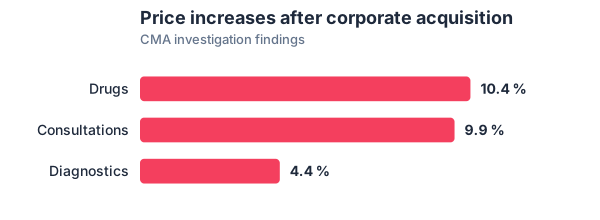
Clients notice when prices jump. And when they feel like they're being pushed toward expensive diagnostics rather than listened to, trust erodes.
Loss of flexibility. An independent owner can waive a fee for a loyal client, stay late for an emergency, or work within a tight budget without seeking approval. Corporate structures often don't allow this discretion – everything must fit the process.
The result is a gap between "retention" and "loyalty." A client might stay on a wellness plan for the discounts while taking their sick pet elsewhere for actual treatment. The subscription holds them financially, but not emotionally.
What independent and locally-owned practices do well
Your advantages are real, even if they're harder to quantify.
Continuity of care. In a locally-owned practice – whether single-site or a small group – clients see familiar faces. They build trust with specific vets and nurses over years. This relationship compounds over time; a client who's been with you for a decade is unlikely to leave for a 10% discount somewhere else.
Contextualised care. You can have honest conversations about budget. Not every limping dog needs an MRI. The ability to say "let's try this first and see how she goes" – without pressure to hit a diagnostic revenue target – builds loyalty that corporate practices struggle to replicate.
Community integration. You sponsor the local dog show. You're on first-name terms with half the town. Your reputation is personal, not institutional. This matters more than marketing spend.
Clinical freedom. You can prescribe what you think is best, not what's on a corporate formulary. You can spend 40 minutes on a complicated case without someone asking why you're behind schedule.
The challenge is that these advantages don't scale automatically. They depend on your team being present and consistent. And they're invisible to new clients who haven't experienced them yet.
Closing the systems gap
The goal isn't to become a corporate group. It's to adopt the systems that genuinely help – automated reminders, online booking, client communication tools – while preserving the autonomy and relationships that make you different.
Automated reminders. This is the lowest-hanging fruit. SMS reminders have a 98% open rate and dramatically reduce no-shows. You don't need a proprietary app – a basic integration with your practice management system gets you 80% of the benefit.
Online booking. Clients expect to book appointments at 10pm on a Sunday. If they can't, some will call elsewhere on Monday morning. Third-party tools like Vetstoria work fine – you don't need to build your own.
Wellness plans. You can run a subscription scheme without being a corporate. Bundle vaccinations, parasite prevention, and a discount on other services into a monthly direct debit. It stabilises your revenue and increases visit frequency – research suggests wellness plan members visit 20% more often than non-members.
The key is to design it around preventive care, not as a lock-in mechanism. A good wellness plan makes the right thing easy for clients – regular check-ups, up-to-date vaccinations, consistent parasite control. A bad one feels like a gym membership they can't escape. Keep the cancellation terms fair and the value proposition clear.
Client communication. Post-visit follow-ups, birthday reminders for pets, recall prompts for overdue vaccinations – these touchpoints are easy to automate and reinforce the relationship. They signal that you're paying attention, even between visits.
Digital records access. Letting clients view their pet's vaccination history or upcoming appointments online isn't complicated, and it removes friction. It's table stakes for younger pet owners.
What not to copy
Some corporate systems exist to serve corporate needs, not client needs.
Aggressive upselling scripts. If your team is trained to push dental packages on every consultation, clients will notice. Recommendations should follow from clinical judgment, not revenue targets.
Dynamic pricing. Raising prices 10% because the market will bear it erodes trust faster than it builds margin. Your pricing should be defensible, not extractive.
Centralised decision-making. The whole point of being independent is autonomy. Don't adopt systems that remove clinical judgment from the consultation room.
Metrics that miss the point. Tracking average transaction value is useful. Optimising for it at the expense of client trust is not. The goal is lifetime value, not maximum extraction per visit.
The buying group option
One corporate advantage you can access directly is procurement pricing. Buying groups – networks of independent and locally-owned practices that negotiate collectively – exist specifically to close this gap.
Groups like the Federation of Independent Veterinary Practices and others allow smaller practices to access near-corporate pricing on drugs and consumables without giving up ownership or control. If you're not already in one, it's worth investigating.
Playing to your strengths
The market is shifting in ways that favour relationships over scale.
Visit frequency is declining while revenue per visit increases – clients are paying more but coming in less often. The gap between visits has widened significantly, meaning pets often present with accumulated issues rather than single problems. In this environment, the practice that retains clients through trust will outperform the one that retains them through inertia.
The CMA's ongoing investigation into veterinary pricing has put corporate practices under scrutiny. Whatever the outcome, it's drawn public attention to the ownership structure of the industry. "Who owns my vet?" is a question more clients are asking – and "we're independently owned" is increasingly a marketable answer.
Corporate chains are optimised for efficiency and scale. You're optimised for relationships and flexibility. The winning strategy isn't to become more corporate – it's to add just enough systems to remove friction, while doubling down on the things that make clients choose you in the first place.
The practices that remain outside the big corporate groups aren't surviving despite the consolidation. They're surviving because a significant segment of pet owners values the relationship with their vet more than the convenience of a corporate system. Your job is to make sure they don't have to choose.
If you're looking for scheduling tools built for independent and locally-owned practices, we're working on something that might help – sign up below to hear when it's ready.
Get notified when VetPlanner launches